Annual Product Quality Review (APQR) as per EU GMP: Example SOP
Contents
- PQR, APR and APQR: what is the difference?
- Indian requirement: revised Schedule M
- Example SOP: APQR for oral solid dosage forms
- 1. Objective
- 2. Scope
- 3. Responsibilities
- 4. Procedure
- 5. APQR record template (outline)
- Common APQR weaknesses
- Frequently asked questions
- Is the APQR mandatory?
- Does it have to be exactly once a year?
- Can products be grouped?
- What if no batch was made during the year?
- References
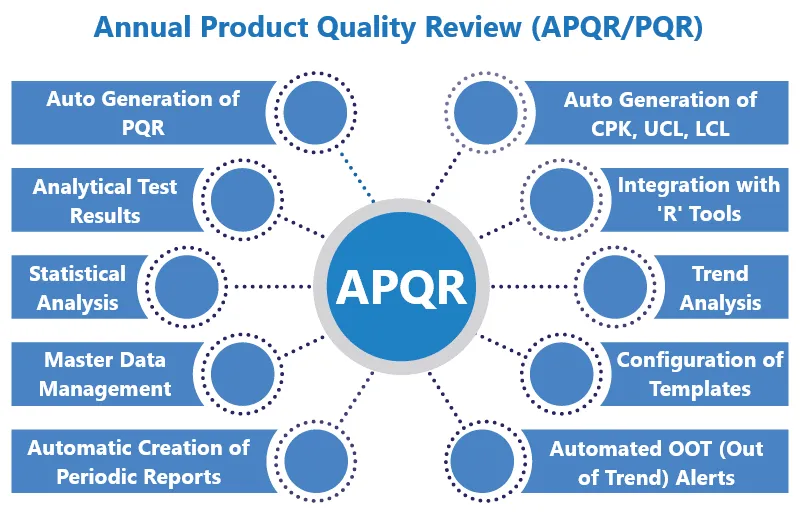
In short: The Annual Product Quality Review (APQR) is a periodic review of every marketed product to confirm the process is consistent, specifications are suitable and improvements are identified. This post gives an example SOP for oral solid dosage forms, built on EU GMP Part I, Chapter 1, section 1.10. It is a template to adapt under your own quality system.
PQR, APR and APQR: what is the difference?
The names are used loosely, but the sources differ.
- Product Quality Review (PQR) is the EU GMP term (Chapter 1, 1.10 to 1.11). It covers all authorised medicinal products, including export-only products, and is normally done and documented annually, taking previous reviews into account. The text says “regular periodic or rolling” reviews, so the cycle can be justified, but annual is the normal expectation.
- Annual Product Review (APR) is the US term from 21 CFR 211.180(e). Records must allow evaluation, at least annually, of the quality standards of each drug product to decide whether specifications or manufacturing and control procedures should change. It requires written procedures and includes review of a representative number of batches (accepted and rejected) and of complaints, recalls, returned or salvaged products and investigations under 211.192.
- APQR is the industry shorthand that many Indian companies use to cover both.
The EU list in 1.10 is more detailed (for example supply chain traceability of active substances, stability trends, MA variations, equipment qualification status and technical agreements). Companies supplying both markets usually write one procedure that satisfies both.
Indian requirement: revised Schedule M
India’s revised Schedule M (Drugs Rules, 1945) was notified as G.S.R. 922(E) on 28 December 2023, and CDSCO inspection documents refer to it as the GMP baseline.
Example SOP: APQR for oral solid dosage forms
This is an illustrative template. Replace the placeholders in your own version with your company name, document numbers and departments.
1. Objective
To describe how the APQR of oral solid dosage products is prepared, reviewed and approved so that it meets EU GMP Part I, Chapter 1 (1.10 and 1.11), and, where applicable, 21 CFR 211.180(e).
2. Scope
This SOP applies to all oral solid dosage products (tablets, capsules and similar) manufactured or marketed by the site, including export-only products. Grouping of products by type is acceptable where scientifically justified (EU GMP 1.11).
3. Responsibilities
| Function | Responsibility |
|---|---|
| Quality Assurance | Owns the SOP; schedules, compiles, reviews and issues the APQR; tracks actions. |
| Production | Batch data, process changes, deviations, yields. |
| Quality Control | In-process and finished product results, OOS, stability data, method changes. |
| Regulatory Affairs | MA variations, post-marketing commitments, regulatory status. |
| Engineering / Validation | Qualification status of equipment, utilities (HVAC, water, compressed gases). |
| Pharmacovigilance / Marketing | Complaints, recalls, returns and safety information as applicable. |
| Head of QA | Final approval. |
4. Procedure
4.1 Review period and schedule
The review is normally prepared every 12 months, taking the previous review into account. Any other review cycle (for example rolling) must be justified in the SOP. A review is also done for products not manufactured in the period, covering stability, complaints, returns, recalls, deviations and regulatory status.
4.2 Content of the APQR
The review should include at least the following items from EU GMP 1.10, adapted as needed for the site:
- Starting and packaging materials: especially from new sources, and supply chain traceability of active substances.
- Critical in-process controls and finished product results, with trends (for example assay, dissolution, uniformity of dosage units, disintegration, hardness, friability, impurities).
- Batches failing specification and their investigations.
- Significant deviations and non-conformances, their investigations and the effectiveness of CAPA.
- Changes to processes or analytical methods.
- Marketing Authorisation variations submitted, granted or refused, including export-only dossiers.
- Stability monitoring programme results and adverse trends.
- Quality-related returns, complaints and recalls and their investigations.
- Adequacy of previous corrective actions on the product, process or equipment.
- Post-marketing commitments, for new authorisations and variations.
- Qualification status of relevant equipment and utilities.
- Contractual arrangements (Chapter 7) are up to date.
The product information section (name, API, strength, dosage form, MA details and sites) is usually added as a header. Pharmacovigilance data is not in the 1.10 list, but many sites add a summary of safety signals as good practice.
4.3 Evaluation and conclusions
QA evaluates the results and decides whether corrective and preventive action or revalidation is needed (EU GMP 1.11). Conclusions cover the consistency of the process, whether specifications remain appropriate for starting materials and the finished product, trends, and improvement opportunities. Actions get an owner and a due date and are followed up in the quality system. Use quality risk management principles (ICH Q9(R1)) when prioritising actions. See Quality Risk Management in the Pharmaceutical Industry.
4.4 Review and approval
The draft is reviewed by Production, QC, Regulatory Affairs and Engineering, and approved by the Head of QA. If the marketing authorisation holder is different from the manufacturer, a technical agreement must define who produces which parts of the review (EU GMP 1.11).
4.5 Records
Keep the APQR and the data used to compile it for the period defined in your record retention procedure.
5. APQR record template (outline)
| Section | Details to record |
|---|---|
| Product information | Name, API, dosage form, strength, route, MA number and date, sites |
| Starting and packaging materials | Suppliers, new sources, traceability |
| In-process and finished product results | Trends, capability, OOT/OOS |
| Failed batches | Batch numbers, investigations |
| Deviations and CAPA | Number, category, effectiveness |
| Changes | Process, method, equipment |
| MA variations | Submitted, granted, refused |
| Stability | Programme, results, trends |
| Complaints, returns, recalls | Count, trends, outcome |
| Qualification status | Equipment and utilities |
| Contracts | Technical and quality agreements current |
| Conclusion and actions | Owner, due date |
| Approval | Reviewers, date |
Common APQR weaknesses
- Data listed without trend analysis or a conclusion.
- Deviations counted but CAPA effectiveness not assessed.
- Review not completed within the planned period or the previous review’s actions not followed up.
- Products with no batches in the period skipped entirely.
See also: Annual Product Review (APQR / APR / PQR), CAPA Process: Step-by-Step Instructions.
Frequently asked questions
Is the APQR mandatory?
Yes in the EU (Chapter 1, 1.10) and the US (21 CFR 211.180(e)). For India, check the product quality review clause of the revised Schedule M.
Does it have to be exactly once a year?
The EU text says “regular periodic or rolling” and normally annually. EMA Q&A allows timeframes to be adjusted with justification based on manufacturing and campaign duration, with criteria in an SOP.
Can products be grouped?
Yes, by product type, where scientifically justified (EU GMP 1.11).
What if no batch was made during the year?
A review is still expected, covering stability results, returns, complaints, recalls, deviations and regulatory background (EMA GMP Q&A).
References
- European Commission, EudraLex Volume 4, EU Guidelines for GMP, Part I, Chapter 1 Pharmaceutical Quality System, sections 1.10 and 1.11 (revision 3, in operation 31 January 2013). A revised Chapter 1 (aligned with ICH Q9(R1), with clarified PQR expectations for product grouping and low-batch products) was consulted on from September to December 2025; until it is adopted, the 2013 text applies.
- EMA, Good manufacturing practice and good distribution practice: Questions and answers (product quality review entries).
- US 21 CFR 211.180(e), Annual evaluation (eCFR).
- ICH Q9(R1) Quality Risk Management, Step 4, 18 January 2023.
- India, Drugs Rules 1945, revised Schedule M, G.S.R. 922(E), 28 December 2023 (CDSCO).
Related articles
CAPA Process: 15 Step-by-Step Instructions for Pharma QA
Follow a 15-step CAPA process from request and root cause to action plan and effectiveness check, with notes on ICH Q10 and GMP expectations for pharma QA teams.
SOP on Change Control in Pharmaceutical Manufacturing
Example SOP on change control: classification, impact assessment, QA approval, implementation, effectiveness check and regulatory notification, aligned to ICH Q10 and EU GMP.
Cleaning Validation Protocol Format and Acceptance Criteria
Cleaning validation protocol format for pharma: sections to include, example acceptance criteria for analytical methods, swab recovery, and common myths.
Data Integrity Problems in an FDA Warning Letter: Lessons
Data integrity findings in a 2022 FDA warning letter: shared admin logins, no audit trail review and weak remediation, explained against 21 CFR 211 and FDA's Q&A.