OOS Investigation Phase Ia and Ib: MHRA Laboratory Stages
Contents
- Where Phase Ia and Ib fit
- Phase Ia: check for an obvious error
- Examples of obvious errors
- Phase Ib: laboratory investigation
- Key terms
- Rules for the analyst and supervisor investigation
- Laboratory investigation checklist (typical points)
- Frequently asked questions
- What is the difference between Phase Ia and Phase Ib?
- Can I simply re-test the sample if I get an OOS result?
- When is a result invalidated?
- Does the US FDA follow the same phases?
- References
In short: In the MHRA approach, a suspect laboratory result is first checked for an obvious error (Phase Ia). If none is found, the analyst and supervisor run a documented laboratory investigation (Phase Ib). If this finds no assignable cause, the case moves to Phase II. This page is for QC analysts, supervisors and QA reviewers.
See also: OOS investigation Phase II (MHRA) | OOS investigation Phase I as per US FDA | Out of Specification and Out of Trend investigations (MHRA)
The UK MHRA published its guidance “Out-of-specification investigations” on gov.uk (first published 28 August 2013, last updated 26 February 2018). It is presented as a flowchart-based slide deck (“Out of Specification & Out of Trend Investigations”, October 2017). This article explains the Phase Ia and Phase Ib parts in plain words. It is a study aid, not a replacement for the MHRA document or your own approved OOS procedure.
Where Phase Ia and Ib fit
The MHRA flow runs from laboratory analysis, to Phase Ia, then Phase Ib, then Phase II (a full-scale investigation when the laboratory cause is not found). A manufacturing investigation, product impact assessment, Phase III and batch disposition follow as needed.
Phase Ia: check for an obvious error
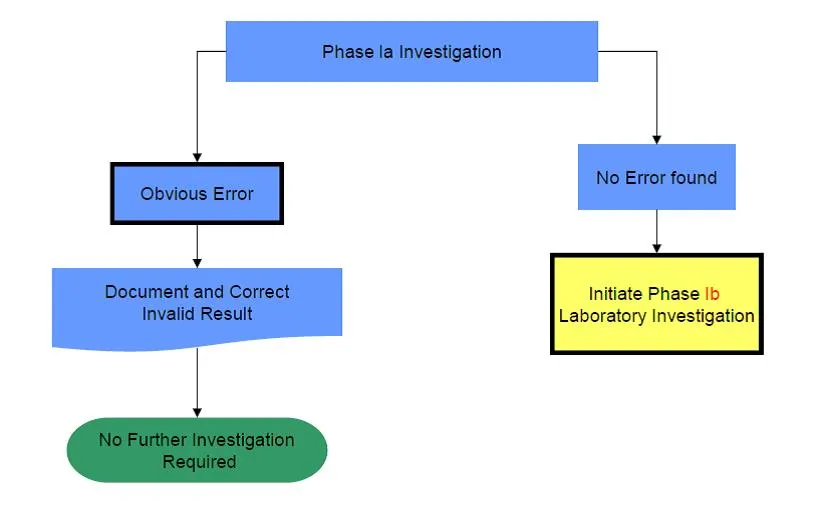
Phase Ia asks one question: is there a clear, obvious error that makes the result invalid? Typical causes are external events such as a power failure, or a mistake the analyst notices before data is generated, such as a spilt sample. In microbiology, the obvious error may only be seen when plates are read.
MHRA expects such events to be trended even when no Phase Ib or Phase II investigation is raised.
Examples of obvious errors
| Situation | What the analyst and supervisor should do |
|---|---|
| Calculation error | Review the calculation together; the correction is initialled and dated by both. |
| Power outage | Document the event and annotate all related records that the analysis is to be repeated. |
| Equipment failure | Document the event, annotate the records and cross-refer to the maintenance record. |
| Testing error (for example spilt solution, incomplete transfer) | Analyst documents it immediately. In microbiology, examples include growth outside the sample area of a plate or failed positive or negative controls. |
| Wrong instrument parameter (for example wrong detector wavelength) | Document and annotate the records, then repeat the analysis. |
If no obvious error is found, a Phase Ib investigation must be started.
Phase Ib: laboratory investigation
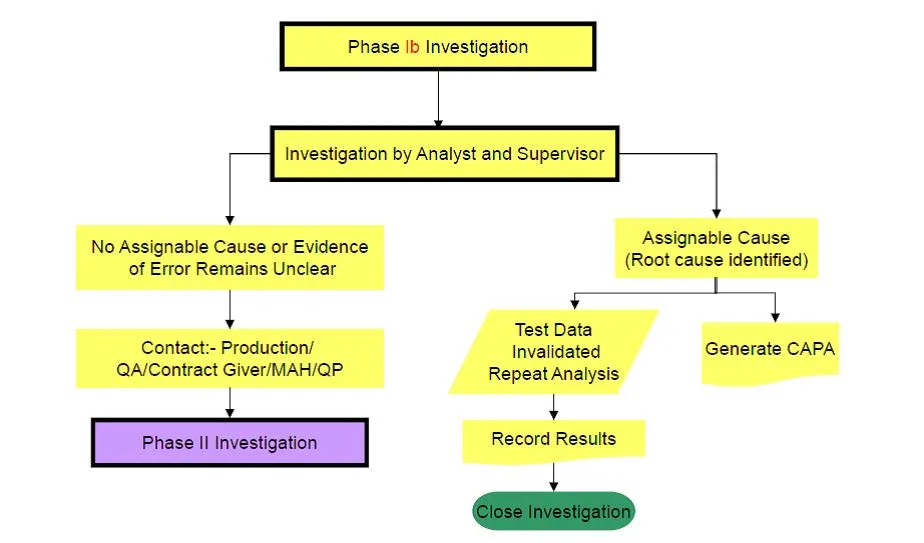
Phase Ib is the first formal investigation, carried out by the analyst and supervisor using a laboratory investigation checklist. Production, the contract giver, the QP or the marketing authorisation holder are contacted as appropriate.
- If an assignable cause (root cause) is found, the test is invalidated, the analysis is repeated and a CAPA is generated.
- If no assignable cause is found, or the evidence is unclear, the investigation moves to Phase II.
Key terms
- Specification: a list of tests, analytical procedures and acceptance criteria that a material should meet to be acceptable for its intended use.
- Acceptance criteria: numerical limits, ranges or other suitable measures against which results are judged.
- Internal specification: an internal limit or action limit, tighter than the regulatory specification.
- Assignable cause: an identified reason for the OOS or aberrant result.
- Invalidated test: a test whose result is set aside because the investigation found an assignable cause.
- Reportable result: the final result as defined in the approved test method, obtained from one full execution of the method starting from the original sample.
- Warning-level or trend excursion: if two or more consecutive samples exceed the alert level, or counts rise or the same organism recurs over a short period, consider treating them as action-level excursions (mainly microbiology).
- Hypothesis (investigative) testing: testing done only to confirm or rule out a possible cause, for example the effect of filtration, sonication or extraction, or an equipment fault.
Rules for the analyst and supervisor investigation
- The review is limited to data, equipment and analysis. No new sample preparation from the original sample is made at this stage.
- Re-measurement can start only after a hypothesis plan is documented, and only to support the investigation.
- Initial hypothesis testing may use the original working stock solutions, but not a fresh preparation from the original sample (that would be re-testing).
- The plan should describe the hypothesis, the samples, the exact testing and how the data will be evaluated. MHRA expects it to be approved by QA or the contract giver before investigational testing. Investigational results cannot replace the original suspect result; they can only confirm or rule out a probable cause.
- For microbiology, keep everything linked to the failure until the investigation is closed: plates, dilutions, product vials, temperature data, pipettes and media. Do not destroy any implicated plates.
Laboratory investigation checklist (typical points)
The checklist is a guide and may not be all-inclusive.
Method, sample and standards
- Correct test method and version followed.
- Correct sample taken and tested; labels and sampling point checked.
- Sample integrity and chain of custody maintained; container storage before use.
- Correct sampling procedure and version followed.
- Possible contamination during testing or re-testing (for example sample left open or unattended).
- Appropriate standards used, and standards and controls behaved as expected.
- Correct specification applied.
Equipment, materials and environment
- All equipment within calibration; equipment logbooks reviewed.
- System suitability met before and during the run.
- Correct, clean glassware; correct pipettes and volumetric flasks.
- Media and reagents prepared per procedure and within expiry.
- Visual examination of solid and solution for abnormal appearance.
- Room temperature and humidity during the test.
- Other activities that could interfere with the test.
Data and people
- Data acceptance criteria met.
- Analyst trained on the method; analyst interviewed about the procedure.
- Raw data checked, including chromatograms and spectra, for unusual peaks.
- Earlier issues with the same assay.
- Other batches in the same analysis set, and other OOS results on this batch.
- Method validation status.
Extra points for microbiology
- Are isolates located where expected (for example glove dab marks, settle plate marks, filter membrane)?
- Were media plates intact, and were samples intact (not leaking) and stored correctly?
- Were samples held for the correct time before testing?
- Was there contamination in other tests run at the same time, including environmental controls?
- Were positive and negative controls satisfactory, and the correct media used and stored properly?
- Were incubation conditions satisfactory?
- Photograph plates, Gram stains and other relevant items at the time of reading.
If the investigation is still not closed after Phase Ib, it proceeds to Phase II.
Frequently asked questions
What is the difference between Phase Ia and Phase Ib?
Phase Ia checks only for a clear, obvious error. Phase Ib is a structured laboratory investigation with a checklist, used when no obvious error is found.
Can I simply re-test the sample if I get an OOS result?
No. A new preparation from the original sample is re-testing and is not allowed during the Phase Ib review. Only a documented hypothesis plan permits limited investigational measurement.
When is a result invalidated?
Only when the investigation identifies an assignable cause with evidence. An invalidation based on assumption alone is not acceptable.
Does the US FDA follow the same phases?
The FDA guidance also separates a laboratory phase from a full-scale investigation, but the terminology differs. See the FDA Phase I post.
References
- MHRA (gov.uk): Out-of-specification investigations, published 28 August 2013, updated 26 February 2018; attached presentation “Out of specification guidance” (Out of Specification & Out of Trend Investigations, October 2017).
- US FDA: Guidance for Industry, Investigating Out-of-Specification (OOS) Test Results for Pharmaceutical Production, Revision 1 (May 2022).
Related articles
Why FDA's OOS Expectations Exist: The Barr Laboratories Case
Why FDA expects strict OOS handling: the 1993 Barr Laboratories ruling on retesting, averaging and outlier tests, and how it shaped FDA's OOS guidance.
OOS Investigation (US FDA): Phase I Laboratory Investigation
Phase I laboratory investigation of an out of specification (OOS) result under US FDA guidance: analyst and supervisor duties, checks and documentation.
OOS Investigation (US FDA): Phase II Full-Scale Investigation
Phase II of an OOS investigation under US FDA guidance: production review, retesting, resampling, averaging, outlier tests and batch disposition decisions.
HPLC Calibration Guide Part 1: Parameters and Procedures
HPLC calibration explained: example calibration parameters and frequencies, with pressure test, drift and noise, oven, flow and gradient checks for QC labs.