Out-of-Trend (OOT) Results: Meaning, Detection and MHRA Expectations
Contents
- What is an out-of-trend result?
- OOS, OOT and atypical results compared
- How OOT is detected: trending approaches
- What MHRA expects
- Flowchart of the MHRA approach
- Practical points for QC and QA
- Frequently asked questions
- Is OOT a regulatory requirement?
- Does an OOT result mean the batch fails?
- Should every OOT result go through Phase I and II?
- Which statistical method should we use?
- References
In short: An out-of-trend (OOT) result is a result that may still be within specification but does not fit the expected pattern of earlier data. MHRA’s guidance treats OOS, OOT and atypical results together and asks for objective detection methods and proportionate investigation. This post explains OOT; for the investigation steps see the linked OOS posts.
See also (OOS procedure): MHRA Phase Ia and Ib, MHRA Phase II, MHRA Phase II and III and the FDA background in why FDA’s OOS expectations exist.
What is an out-of-trend result?
According to MHRA’s training slides, an OOT result is generally a stability result that does not follow the expected trend, either compared with other stability batches or with earlier results in the same study. Trends of starting materials and in-process samples can also produce OOT data. The result is not necessarily OOS, but it does not look like a typical data point.
MHRA also describes an atypical (aberrant or anomalous) result: one that is within specification but unexpected or questionable, for example a chromatogram with unexpected peaks.
OOS, OOT and atypical results compared
| OOS | OOT | Atypical / aberrant | |
|---|---|---|---|
| Within specification? | No | Usually yes | Yes |
| Compared against | Acceptance criteria (compendia, filings, internal limits) | Expected pattern from earlier data or other batches | Normal behaviour of the test or sample |
| Typical example | Assay below the limit | Impurity rising faster than earlier batches | Unexpected peak in an otherwise passing chromatogram |
How OOT is detected: trending approaches
Objective methods, usually statistical, help find OOT data early. The right method depends on the product, test and amount of data, and it should be defined in an SOP. Common approaches, given here as examples only:
- Stability trending: compare each new time point with the regression line or prediction interval from earlier time points or earlier batches, and flag points outside it.
- Control charts: plot results over time against a centre line with control limits; flag points beyond limits or unusual runs. Typical examples are Shewhart-type rules (a point beyond three standard deviations, or several consecutive points on one side of the centre line). These rules are illustrative, not an MHRA requirement.
- Environmental and microbiological monitoring: alert and action level trends, such as consecutive samples above the alert level or a rising count. MHRA’s slides suggest considering such cases as action-level excursions.
- Batch-to-batch comparison: compare the same test across batches at the same stability time point.
What MHRA expects
The MHRA page “Out-of-specification investigations” on GOV.UK was first published on 28 August 2013 and last updated on 26 February 2018. The guidance itself is in an attached slide deck titled “Out of Specification & Out of Trend Investigations” (October 2017), which says it complements FDA’s OOS guidance. The page text lists the OOS phases but does not mention OOT; the OOT points are in the attachment.
From that deck:
- OOS, OOT and atypical results should be investigated for batch release testing, starting materials, in-process testing used for batch decisions, marketed-product stability, on-going stability and clinical trial batches.
- If a test normally passes at the first level but one sample has to go to the next level (for example in compendial staged tests), this does not follow the normal trend and should be investigated.
- Stability OOS and OOT situations should be escalated as soon as the suspect result is found. If an abnormal result predicts OOS before the next time point, extra testing should be scheduled earlier.
- OOT alerts can be grouped as analytical, process control and compliance alerts, and the depth of investigation should grow with the alert level. An analytical alert is a single aberrant result within specification. A compliance alert is where the OOT result suggests OOS could occur before expiry.
- Historical data are needed to identify OOT alerts.
FDA’s OOS guidance (Revision 1, May 2022) also notes that much of its content may be useful when examining results that are out of trend.
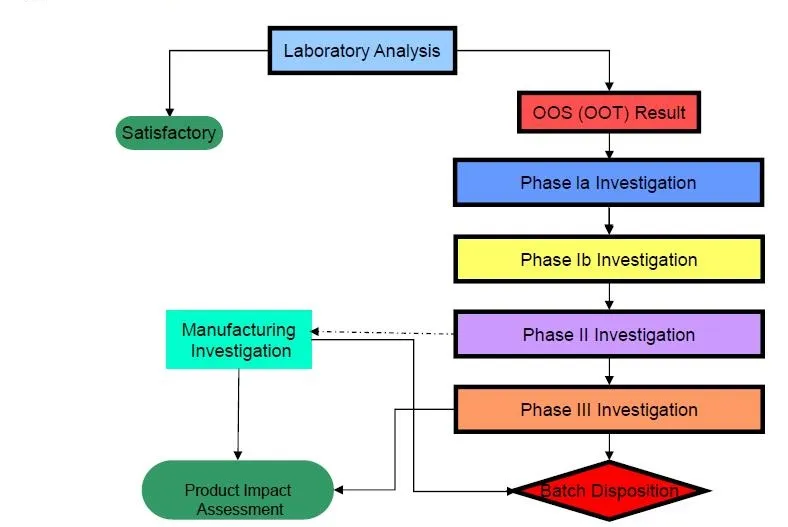
Flowchart of the MHRA approach
Practical points for QC and QA
- Define in an SOP what counts as OOT for each product and test, and how it is calculated.
- Use enough historical data; trending on very few batches can be misleading.
- Record each OOT alert, its classification and the decision, even when no OOS follows.
- Review trends periodically as part of the product quality review.
Frequently asked questions
Is OOT a regulatory requirement?
Regulators expect firms to detect and handle unexpected trends. MHRA’s training deck includes OOT alongside OOS. Whether a specific numerical rule is required depends on your quality system; the rule itself is set by you.
Does an OOT result mean the batch fails?
No. An OOT result is not necessarily OOS. It triggers evaluation, and the depth depends on the alert level and the risk of reaching OOS before expiry.
Should every OOT result go through Phase I and II?
MHRA says stability OOS and OOT situations follow the investigation described for Phase I and Phase II. Proportionate depth is expected, based on alert level.
Which statistical method should we use?
There is no single prescribed method in the MHRA material. Choose and justify one, and document it in an SOP.
References
- MHRA, GOV.UK: Out-of-specification investigations, first published 28 August 2013, updated 26 February 2018; attachment “Out of Specification & Out of Trend Investigations”, October 2017.
- US FDA, Guidance for Industry: Investigating Out-of-Specification (OOS) Test Results for Pharmaceutical Production, Revision 1, May 2022.
Related articles
Why FDA's OOS Expectations Exist: The Barr Laboratories Case
Why FDA expects strict OOS handling: the 1993 Barr Laboratories ruling on retesting, averaging and outlier tests, and how it shaped FDA's OOS guidance.
OOS Investigation (US FDA): Phase I Laboratory Investigation
Phase I laboratory investigation of an out of specification (OOS) result under US FDA guidance: analyst and supervisor duties, checks and documentation.
OOS Investigation (US FDA): Phase II Full-Scale Investigation
Phase II of an OOS investigation under US FDA guidance: production review, retesting, resampling, averaging, outlier tests and batch disposition decisions.
HPLC Calibration Guide Part 1: Parameters and Procedures
HPLC calibration explained: example calibration parameters and frequencies, with pressure test, drift and noise, oven, flow and gradient checks for QC labs.